
How radon gets into a Colorado home
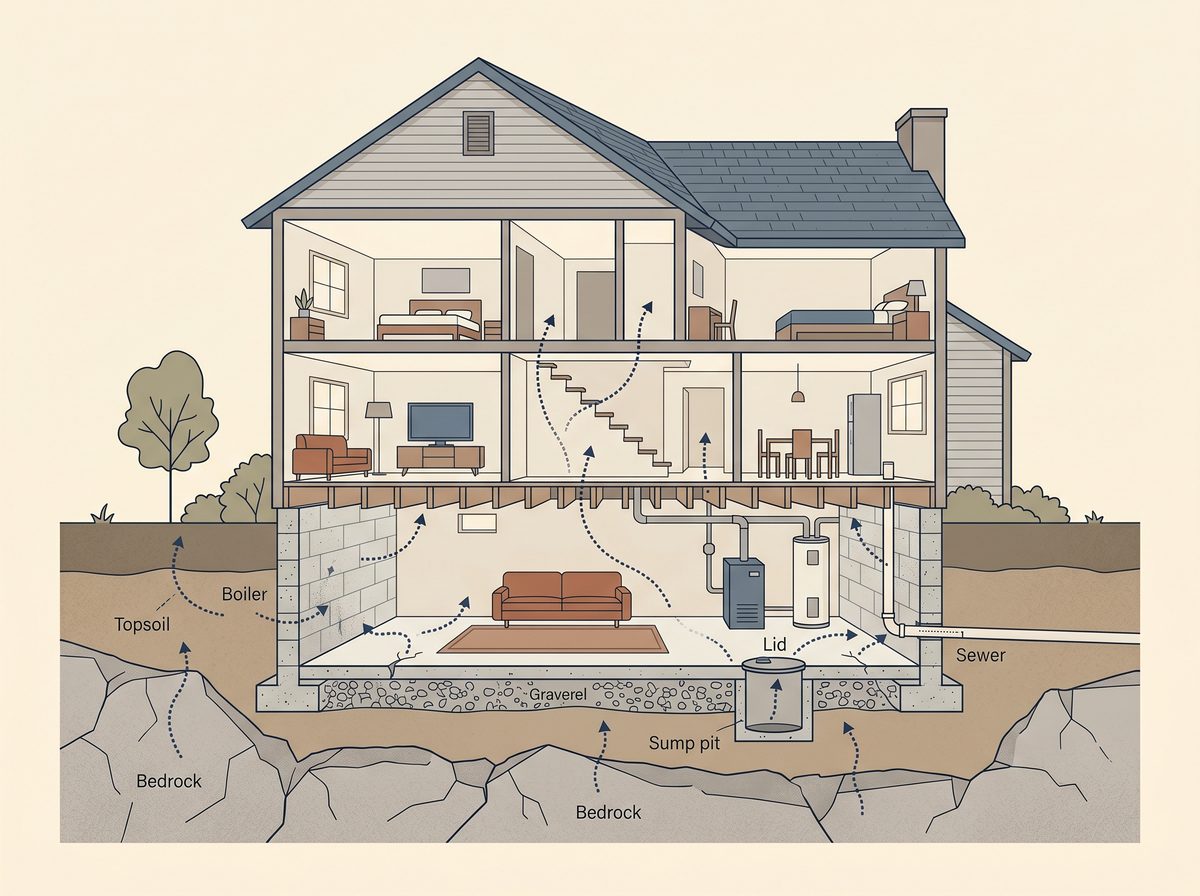
Radon is an invisible, odorless gas produced by the natural decay of uranium in soil and rock. Colorado's Rocky Mountain geology is uranium-rich, so radon levels under homes here are higher than in most of the U.S. — the EPA places most of the Front Range, including El Paso County, in Zone 1: the highest indoor radon potential. (53 of Colorado's 64 counties are Zone 1; see the Colorado radon map for full context.)[2]
The gas rises out of the soil and finds its way indoors through small openings in the foundation: hairline slab cracks, the gap where the floor meets the wall, plumbing penetrations, sump pits, and unsealed crawl spaces. Once inside, it accumulates in lower levels — basements first, then living areas above.
Two things matter: most Colorado homes have some radon, and you can't tell by sight or smell whether yours is above the action level. The only way to know is a test.
Step one is always testing
You cannot smell, see, or feel radon. The only way to know your level is to test. CDPHE recommends every Colorado home be tested, and EPA guidance is to retest every two years or after major remodels or HVAC changes.[1]
You have three practical options:
- Short-term DIY kit (2–7 days). Low-cost, available at retail and from CDPHE programs.
- Long-term DIY kit (90+ days). Better picture of year-round exposure.
- Professional measurement by a tester certified through the National Radon Proficiency Program (NRPP) or the National Radon Safety Board (NRSB), required for real estate transactions.[4]
Our Colorado Springs testing guide walks through each option, what they cost, and how to read the result.
If your test is high, the fix is straightforward
A result at or above 4.0 pCi/L is the EPA's action threshold. The standard fix is active sub-slab depressurization — a sealed vent pipe and a quiet electric fan that pulls radon from under the slab and exhausts it above the roofline. Homes with crawl spaces use a sub-membrane variant; sump pits and drain tile can be tied into the same system.
A correctly designed system typically reduces indoor radon by 80–99%.[2] CDPHE and El Paso County both put a typical Colorado mitigation system in the $1,000–$2,000 range, with larger or more complex installations costing more.[1][5] Our cost page breaks down what drives the price.
Caulking, sealing, or running fans alone is not a substitute for a properly engineered system. CDPHE notes that sealing cracks alone is unreliable and can sometimes make things worse.[1]
What Colorado law and licensing actually say
Two recent changes shape every Colorado radon decision:
- Contractor licensing (July 2022). All radon measurement and mitigation professionals working in Colorado must be certified through NRPP or NRSB and registered with the Colorado Department of Regulatory Agencies (DORA) Office of Radon Professionals. Always verify a contractor's registration before hiring.[4]
- Real estate disclosure — SB23-206 (2023). Every residential sale and lease in Colorado must include a radon warning, any known test results, and any mitigation history. The CDPHE radon brochure must be provided. After January 2026, tenants gain additional remedies if a known elevated radon level was not mitigated.[6]
Important nuance: Colorado does not require a seller to test or mitigate — only to disclose what they know.[1] "No disclosure" usually means "no test was done," not "no radon."
Pick your area
Currently building local guides for Colorado Springs and Denver, with more Colorado areas coming. Outside these two? The statewide pillar pages (testing, mitigation, cost, contractor selection) apply everywhere in Colorado — and the quote form routes by ZIP, not city.
Colorado Springs
El Paso County is EPA Zone 1; more than 40% of homes tested 2005–2023 came back high. Start here for testing, mitigation cost, and what to do after a failed result.
Denver
Denver and every Denver Metro county sits in EPA Zone 1. Denver's housing mix — older bungalows, full basements, finished lower levels — directly shapes how testing and mitigation play out. Start here if you live in Denver or the metro.
Other Colorado area
The site's pillar pages — testing, mitigation systems, cost, choosing a contractor — apply statewide. Tell us what city you'd like covered next.
Statewide pillars
Colorado Radon Guide is an independent editorial resource. We do not install mitigation systems and are not a contractor. When you request a quote, your information is routed to one licensed Colorado mitigation partner. More about us · How leads are routed.