
El Paso County is in EPA Zone 1, the highest predicted-radon classification. The Colorado Radon Map shows how El Paso County compares to the other 63 Colorado counties and what the EPA zone classification does and doesn't tell you about your specific home.
How radon gets into a Colorado Springs home
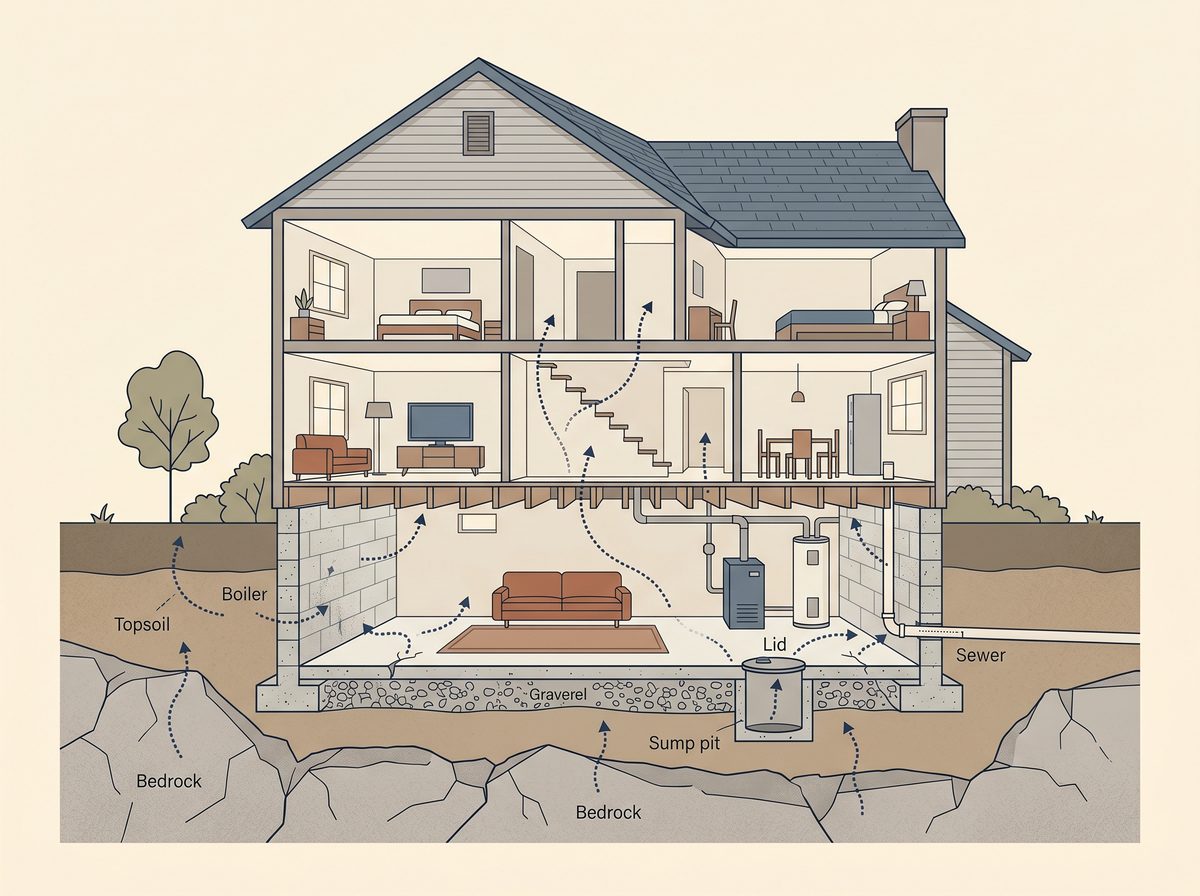
The same uranium-rich Rocky Mountain geology that gives Colorado Springs Pikes Peak as a backdrop is the reason radon is common indoors here. Radon is the natural decay product of uranium in soil and rock, and the EPA classifies El Paso County in Zone 1: the highest indoor radon potential.[2]
The gas rises out of the soil under and around the foundation, finds its way through cracks, sump pits, drain tile, and crawl-space openings, and accumulates indoors. Basements and finished lower levels see the highest readings; slab-on-grade homes still have radon but typically less than multi-level homes.
That's why both CDPHE and El Paso County Public Health recommend every home in the county be tested.[1][5]
Step 1 — Test
Every Colorado Springs home should be tested. CDPHE recommends testing at least every two years and after any major remodel or HVAC change. Short-term DIY kits are the fastest way to find out where you stand; long-term kits give a more complete year-round picture.
For real estate transactions, the test must be performed by a professional certified through NRPP or NRSB and registered with the Colorado DORA Office of Radon Professionals.[3]
Step 2 — If you're above 4.0 pCi/L, mitigate
The standard mitigation system in Colorado Springs is active sub-slab depressurization: a sealed PVC vent pipe runs from beneath the slab up through the home and discharges above the roofline, pulled by a quiet electric fan in the attic, garage, or exterior. Crawl-space homes use a sealed sub-membrane variant. Sump pits and drain-tile loops can be tied into the same system.
A properly designed system reduces radon by 80–99%.[4] Sealing cracks alone is not a fix and is sometimes counterproductive.[5]
How much does mitigation cost in Colorado Springs?
Use this as a quick orientation, then read the full cost guide for what moves the price.
| Scenario | Typical range |
|---|---|
| Single-family home, single suction point, exterior fan | $1,000–$1,500 |
| Larger home, multi-level, finished basement | $1,500–$2,500 |
| Crawl space with vapor barrier work | $1,800–$3,000 |
| Multiple suction points or unusual foundation | $2,500+ |
Estimates only. Confirm with a written quote from a licensed Colorado contractor. CDPHE places the typical baseline at $1,000–$2,000.[5]
If your test came back high
A reading above 4.0 pCi/L is the EPA action threshold. What you do next depends on whether you're a homeowner without a transaction pending, a buyer or seller under contract, or a tenant or landlord:
- Confirm the reading with a second test or continuous monitor
- Get at least two written quotes from licensed contractors
- If you're under contract, calculate the closing timeline before negotiating
How to verify a Colorado radon contractor
Since July 2022, every radon measurement and mitigation contractor in Colorado must be certified through NRPP or NRSB and registered with the Colorado DORA Office of Radon Professionals.[3]
Before you sign anything, ask for:
- Their NRPP or NRSB certification number
- Their Colorado DORA registration
- A written scope: number of suction points, fan model and warranty, sealing work, exhaust routing, permit handling
- A post-installation test included in the quote
- A written warranty on the system (fan warranties are typically 5–10 years)
Radon and real estate in Colorado
Colorado SB23-206, in effect since 2023, requires every residential sale or lease to include a radon warning and disclosure of known test results and any mitigation. Sellers and landlords must provide the CDPHE radon brochure. Colorado does not require sellers to test or mitigate — only to disclose what they know.[6]
For tenants, after January 2026, additional remedies apply if a landlord knew the property had elevated radon and did not mitigate. CDPHE maintains a dedicated real estate page with the current brochure and forms.
Frequently asked questions
Is radon actually a problem in Colorado Springs, or is this overblown?
El Paso County Public Health reports more than 40% of homes tested between 2005 and 2023 were above the EPA action level. The county is in EPA Zone 1, the highest indoor radon category. It's a real, locally documented issue — not marketing.[1]
How long does mitigation take?
Most single-family installations take one day. Add a few days to schedule, plus a post-installation test (which is typically 48 hours). A reasonable end-to-end timeline is one to two weeks once you've signed a quote.
Will I have to retest after mitigation?
Yes. A post-mitigation test confirms the system is working. Reputable contractors include this in the quote. After that, EPA guidance is to retest every two years.[4]
Do air purifiers fix radon?
No. Radon is a soil gas; it has to be redirected away from the home's foundation. Air purifiers don't address the entry pathway and the EPA does not recommend them as a substitute for mitigation.[2]
Does Colorado Springs require a permit for mitigation?
Mechanical and electrical work on a mitigation system may require a permit; your licensed contractor will pull it. Always confirm the permit is included in the written quote.
What if I can't afford mitigation?
CDPHE administers a low-income radon mitigation assistance program. Eligibility and funding vary year to year; check the CDPHE radon page for the current details.[5]
Colorado Radon Guide is an independent editorial resource. We do not install mitigation systems and are not a contractor. When you request a quote, your information is routed to one licensed Colorado mitigation partner. More about us · How leads are routed.